Our first Book Phoenix Kit delivery lands in Colombia.
Our Q1 rollout delivered 300 books, school supply kits, and backpacks to a rural school on Colombia's Caribbean coast.
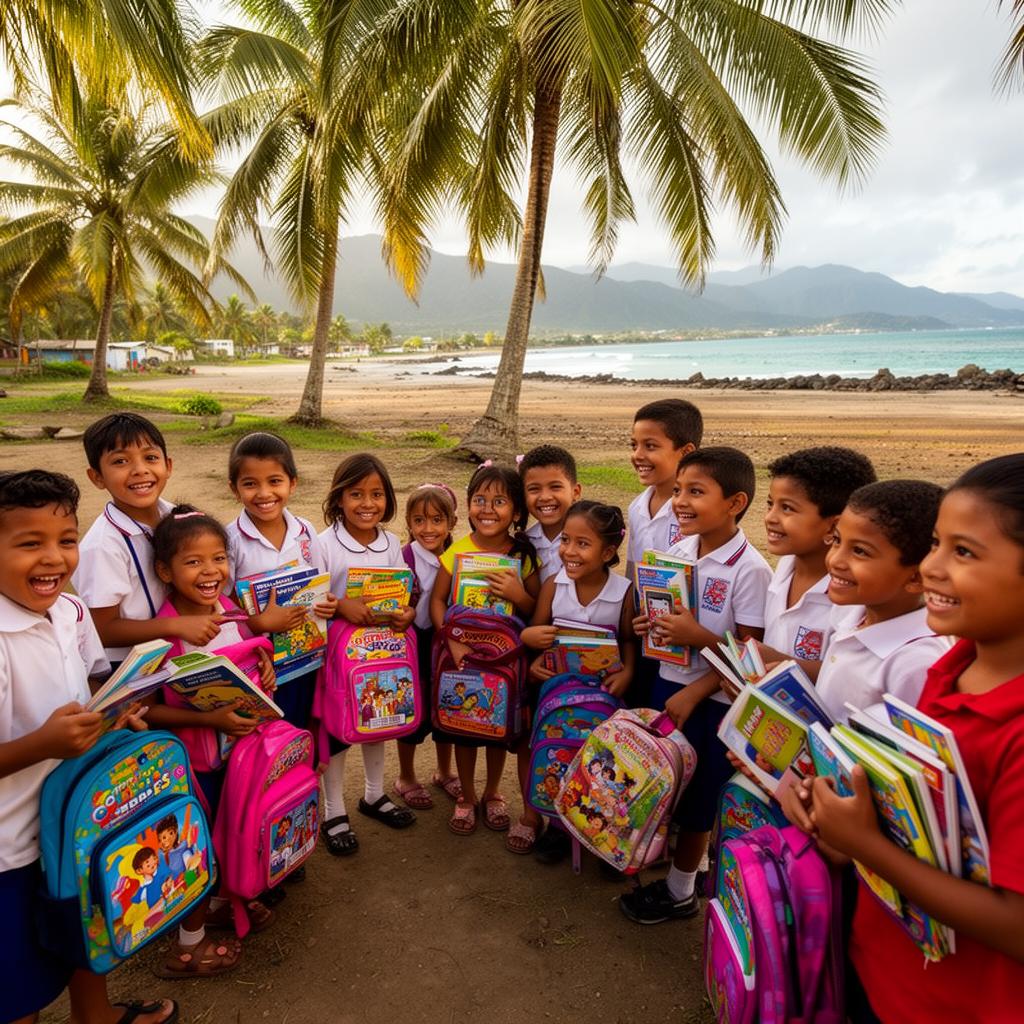
On the morning of March 14, between the green wall of the Sierra Nevada de Santa Marta and the gray-blue line of the Caribbean Sea, the first Rising Phoenix Book Kit arrived in La Guajira. The community sits at the edge of indigenous Kogi and Wiwa territory, a place where the road from Santa Marta gives way to dirt paths and the river runs cold straight down from the mountains. For most of the children who gathered that morning, smelling of sunscreen and river water, it was the first time they had ever received a set of books and school supplies they could truly call their own — and they came with backpacks, notebooks, pencils, art supplies, and hygiene kits they could take home and keep.
The connection began nineteen months ago, on a scouting trip that was supposed to last four days and ended up lasting two weeks. We had come to La Guajira to meet with the principal of the local primary school, Doña Marta Ospino, who had written to us after reading about our work in a Bogotá newspaper. Her school served just over 300 children from the town and the surrounding veredas, and its entire book collection — every textbook, every reader, every dog-eared paperback — fit on a single rolling cart that lived in the corner of her office. We sat in that office for three hours that first afternoon while she told us, child by child, who she was worried about and why. Most of them, she said, didn't even have pencils at home.
The first delivery included 300 carefully chosen books and a full set of School Supply Kits — one for every child in grades one through five. Each kit contained a durable backpack, three notebooks, two pencils, an eraser, a set of colored pencils, a ruler, and a basic hygiene pack. The books were divided in three: roughly a third in Spanish, a third in bilingual Spanish-English editions for the older students preparing for secondary school, and the final third picture books, early readers, and folk-tale collections in Wayuunaiki and Kogi — languages that, until very recently, almost never appeared in print at all. Sourcing those indigenous-language titles took the better part of six months and required us to work directly with small independent publishers in Bogotá, Riohacha, and Valledupar, as well as two cultural foundations that have been quietly recording oral histories from Sierra Nevada elders for the past decade. Several of the books in our kit are first editions of stories that, a generation ago, existed only in spoken form.
The crates arrived by truck at dawn. Two local carpenters, Hernán and Wilmer, who had volunteered to help with unloading, treated the delivery as a point of personal pride and showed up before sunrise. A team of parents helped carry the boxes into the schoolyard, turning the morning into something between a community gathering and a celebration. Doña Marta had picked the location herself — a shaded corner of the schoolyard where the breeze comes off the river and the afternoon sun is broken by a stand of mango trees. The children lined up by grade, and one by one each received a backpack with their name on it.
On distribution day, 84 children received their kits between nine in the morning and four in the afternoon. A few sat down with a book almost immediately and didn't get up for two hours — one girl, about eight, read an entire illustrated biography of Frida Kahlo without lifting her head, then closed it, opened her backpack, and started a second one. Others took longer to settle. They pulled supplies out of their packs, tested the colored pencils on spare paper, conferred with siblings and friends, sounded out titles under their breath. A boy of eleven named Yair, who his teacher had quietly warned us was 'not really a reader,' spent forty minutes with an atlas from his kit, tracing the coastline from La Guajira all the way around to Cartagena and then up through Panama, asking anyone who would listen what the names of the places meant. By the end of the afternoon, every single child had a backpack with their name written on it, a fresh notebook, and a stamp, in red ink, of a small phoenix on the inside cover.
We want to be honest about what a kit delivery does and does not do. It does not, by itself, fix a school. It does not put food on the table at home, or repair a road, or guarantee that a child finishes secondary school in a region where many do not. What it does do, in our experience, is change the texture of a child's afternoon — and change it consistently, day after day, for as long as the supplies last and the books remain in hand. It gives a kid who was bored a thing to do that is theirs. It gives a kid who was struggling in class the tools to practice at home without anyone watching. It gives a kid who already loves to read the staggering, life-altering discovery that there is more where that came from. That is the thing we are trying to deliver here, and it is the thing we will measure ourselves against.
What happens next matters more than the first delivery. Doña Marta and a local parent volunteer, Yulieth Rodríguez, who grew up in the community and came home after finishing her degree in education in Santa Marta, will track which children finish their books, which supplies run out first, and which titles the older students start requesting by name. We have committed to a quarterly replenishment — fresh notebooks, replacement pencils, and a rotating selection of chapter books — for at least the next two years. The next shipment, heavy on middle-grade novels the older students have already started asking for, is scheduled for June. On Saturdays, Yulieth will lead a read-aloud hour for parents and younger siblings, using the picture books from the kits. In a community where many adults did not finish primary school, that hour is as much for the grown-ups as it is for the kids.
We will also be tracking, quietly and carefully, a small set of outcomes: how many books each child reads per month, how reading levels move over the course of the school year, how many children use the supplies at home, and — most importantly — what the children themselves tell us when we ask whether the kits have changed anything for them. We will publish those numbers, honestly, on this blog every six months. If something is not working, we want you to know. If something is working better than we hoped, we want you to know that too.
To everyone who funded a backpack, sponsored a title, sewed a kit bag, packed a supply crate, drove a truck up the coastal road, or simply shared our work with a friend — thank you. This delivery belongs to this community now. It belongs to Doña Marta and Yulieth and Hernán and Wilmer; to Yair and the girl who read about Frida Kahlo; to the parents who volunteered their Saturday morning and the elders whose stories now sit, in print, inside a backpack their grandchildren can carry home. We are already planning the next one.